How Contour Lines Work
Contour lines are the language mountains use to describe themselves on paper. Each line traces a path of constant elevation across the landscape—an invisible horizontal slice through the Earth's surface, made visible.
The Basic Idea
Imagine filling a lake around a mountain, one level at a time. At each water level, the shoreline traces a ring around the mountain. That ring is a contour line. Raise the water ten meters, and you get a slightly smaller ring higher up. Keep going and you produce a set of nested rings—each one representing a different elevation.
On a map, these rings are flattened and drawn from above. The result is a pattern of nested curves that encodes the three-dimensional shape of the terrain in two dimensions. Every point along a single contour line sits at exactly the same height above sea level.
What the Spacing Tells You
The distance between contour lines is the most important thing to read on a topographic map. It tells you how steep the ground is:
Reading the terrain from line spacing:
- Lines close together — Steep terrain. The elevation changes rapidly over a short horizontal distance. A cliff face produces lines so close they nearly merge.
- Lines far apart — Gentle slope. The land rises gradually. A wide plain or rolling hill shows widely spaced, sweeping curves.
- Lines evenly spaced — Constant slope. A uniform hillside, like the side of a volcanic cone, produces evenly distributed rings.
- Lines that form a V — A valley or drainage. The V points uphill, toward higher ground. Rivers flow through the opening of the V.
- Concentric closed rings — A summit or hilltop. The innermost ring is the highest point. The tighter the rings, the steeper the peak.
Contour Interval
The contour interval is the vertical distance between each line. On a map with a 40-foot interval, each consecutive contour represents a 40-foot change in elevation. The choice of interval depends on the terrain:
Flat coastal plains might use 10-foot intervals to show subtle features. The Himalayas might use 100-meter intervals to keep the map readable. Choosing the right interval is an art—too small and the map becomes an illegible thicket of lines, too large and the terrain's character disappears.
On USGS topographic maps, index contours appear every fifth line, drawn thicker and labeled with the elevation value. Between them, four thinner intermediate contours fill in the detail. This hierarchy makes it easy to count elevation at a glance.
The Shapes of Terrain
Once you learn to read contour lines, a flat map becomes a three-dimensional landscape in your mind. Each landform has a distinctive contour signature:
Common landforms and their contour patterns:
- Volcanic cone — Nearly perfect concentric circles, evenly spaced. Mount Fuji is the textbook example.
- Ridge — Contour lines form elongated U-shapes pointing away from the high ground, like nested horseshoes.
- Saddle (col) — An hourglass pattern between two peaks. Contour lines pinch inward from both sides.
- Cliff — Lines merge together or overlap. On some maps, a cliff is shown with tick marks pointing downslope.
- Bowl or cirque — A horseshoe of closed contours opening in one direction, carved by glaciers.
- River valley — V-shaped contours crossing a watercourse, with the V always pointing upstream.
Where the Data Comes From
Modern elevation data is collected by satellite radar (NASA's SRTM mission mapped nearly the entire Earth in 2000), airborne LiDAR (laser pulses bounced off the ground from aircraft), and photogrammetry (stereo photography from satellites like those in the USGS 3D Elevation Program).
The most detailed publicly available dataset for the United States is the USGS National Elevation Dataset, with resolution down to 1 arc-second (approximately 30 meters). Some areas have even finer 1/3 arc-second data. Globally, the Copernicus DEM provides 30-meter resolution worldwide.
This is the data that powers Topo Prints. When you search for a location, we fetch real elevation measurements and generate contour lines from them in real time. What you see on screen is the actual shape of the Earth at that place.
A Brief History
Contour lines were first used on a map in 1791 by the French cartographer J.L. Dupain-Triel for a map of France. But they didn't become standard until the mid-1800s, when the Swiss pioneered their use for Alpine mapping. Before contour lines, cartographers used hachures—short lines drawn in the direction of steepest slope—which showed the general shape of terrain but couldn't convey precise elevation.
The U.S. Geological Survey began systematic topographic mapping in 1879. Over the next century, USGS surveyors mapped the entire country at 1:24,000 scale—the famous 7.5-minute quadrangle series. More than 55,000 individual maps, each covering roughly 50 square miles, all rendered in contour lines.
Today, those analog techniques have been replaced by digital elevation models and algorithmic contour generation. But the visual language remains the same: a contour line in 2026 means exactly what it meant in 1791.
From Cartography to Art
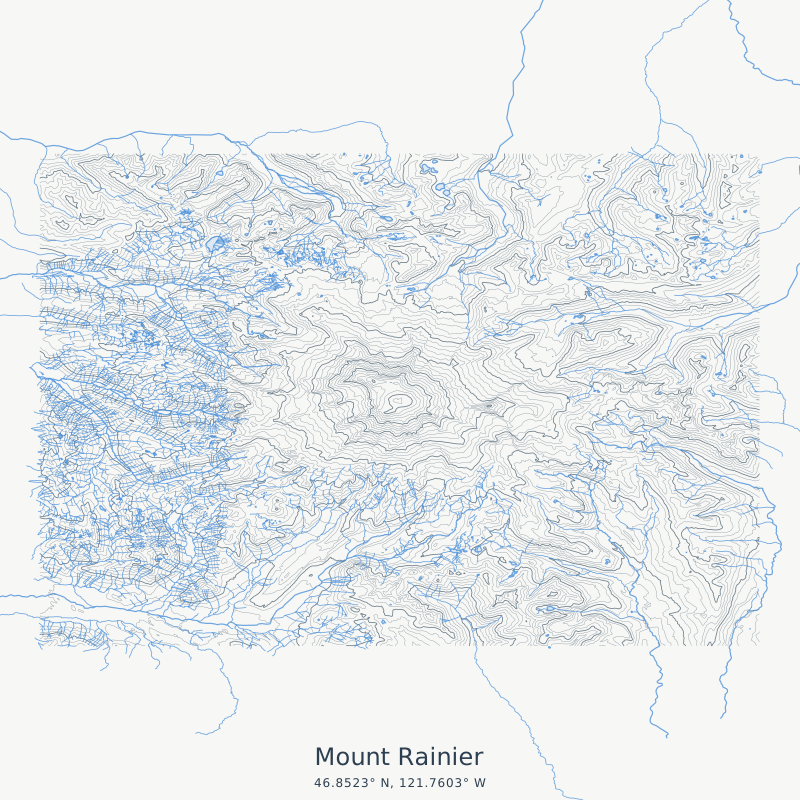
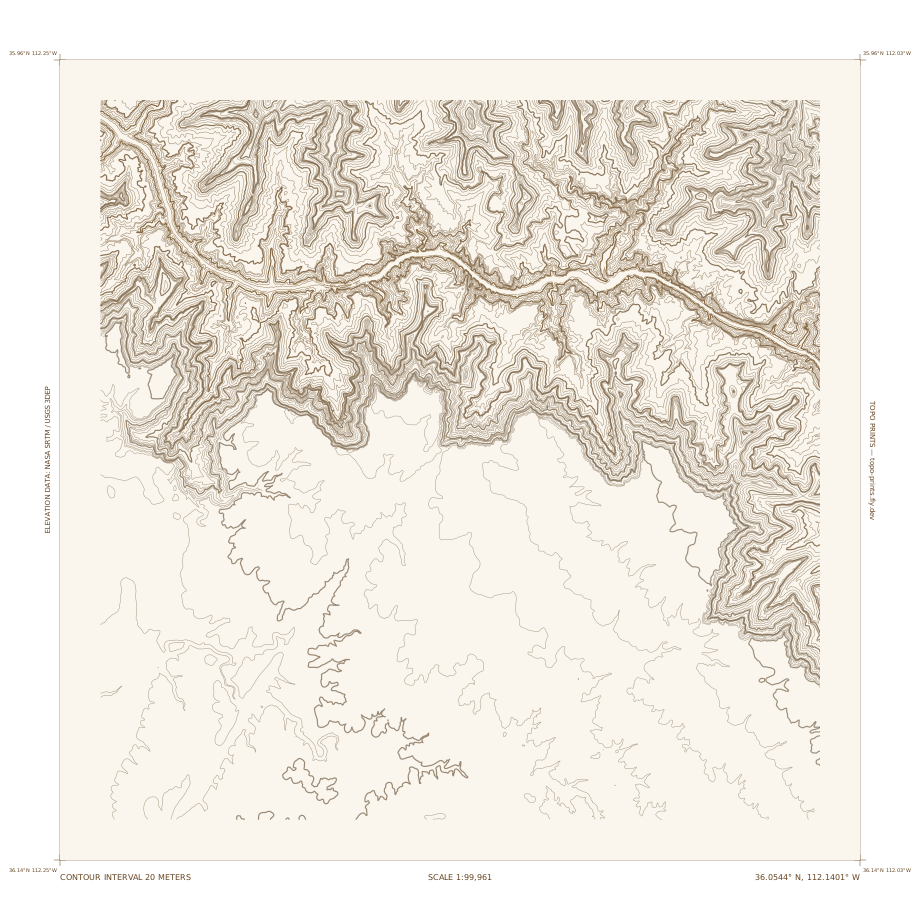
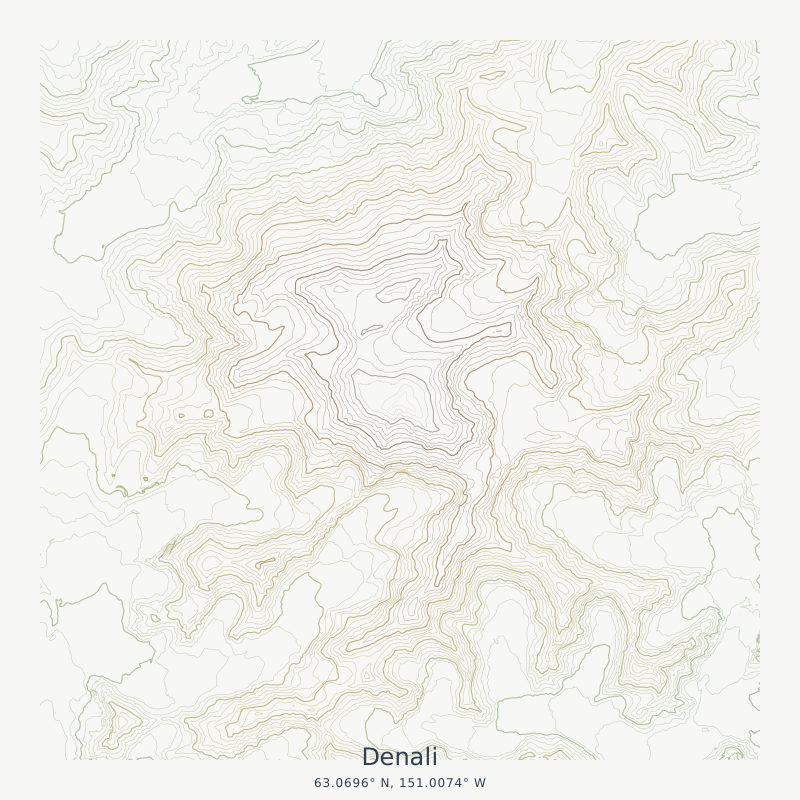
Stripped of labels, roads, and grid lines, contour maps become something unexpected: abstract art generated by geology. The patterns are mathematically precise—each line computed from elevation data—yet they look organic, almost biological. A mountain's contour pattern resembles a fingerprint. A coastline's contours flow like wood grain.
This is what makes topographic art compelling. It's not invented or composed by an artist's imagination. It's a direct rendering of how the Earth actually looks when you peel away everything except shape. Every swooping curve, every tight cluster of lines, is real.
See the Contours of Any Place on Earth
Search a location, preview the terrain, and create your own topographic art print.
Start Creating